
A Beowulf Sonnet
Writing poetry is difficult, who knew?

There’s something about poetry.
There’s something about Beowulf.
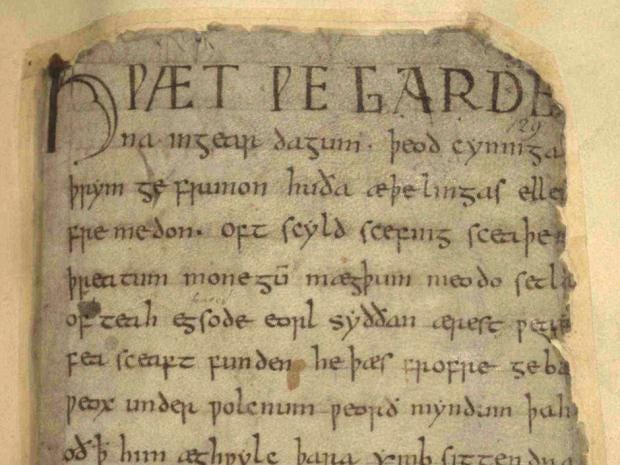
I’ve always wanted to try my hand at writing poetry. After all, my favorite authors ever all were poets: Tolkien, Lewis, Shakespeare, a whole bunch of Anons. I am inspired by current poets like Malcolm Guite and Luci Shaw and Wisława Szymborska. I’d like to imaging trying my hand at making the literary landscape a little more beautiful, hearkening back to good, old stories through revived poetry (see Guite’s newest Arthuriad for inspiration). It’s a pipe dream to be sure.
An assignment last fall provided me with an opportunity to try my hand at possibly creating poems based on one of the books we read in medieval literature. Naturally, I chose Beowulf. Because as well as having always wanted to be a poet, I have a strange urge to collect Beowulf translations whenever I see one in a used bookstore and have done so for years. Rather inexplicably and possibly quite randomly.
The assignment was called the “Unessay.” The only requirements were to incorporate the themes of the class in some way and use one of the texts. Many of my classmates were hugely creative: writing songs in the Anglo-Saxon style, creating stop animation videos of the Wife of Bath, a paper-pieced quilts with scenes of the life of Eleanor of Aquitaine, short stories based on the trial records from Joan of Arc, etc.
Initially, I set out to write an undetermined number of sonnets. I wanted to write about the hearth of Heorot, Hrothgar’s wisdom, Wealtheow’s peace keeping tactics, Wiglaf’s loyalty, the Beowulf manuscript, and Beowulf’s battles with Grendel, Grendel’s mother, and the dragon. Eight sonnets should be easy enough to manage, right?
Wrong.
Friends, I was not initially successful.
Writing poetry is HARD.
I spent hours upon hours counting out syllables, scanning line(s), and trying to figure out imagery. It did not help that my husband, who is a natural poet, produced a sonnet in maybe 10 minutes, let’s be generous and say 15. His was amusing and witty. I was seeking lofty. Maybe that’s why I failed. I wanted to jump 10 steps further than my ability allowed. I should have maybe started with 3, but being a human with a rather robust tendency toward overachieving, I couldn’t settle for creating underdeveloped poetry.
So I stopped writing poems. Naturally.
I pivoted the assignment and wrote a series of lesson plans instead. I did have a lot of fun with the lesson plans; it’s strangely something I do well and enjoy. Can you spell teacher-nerd? Ha!
The poems, or lack thereof, still niggled at my brain though. There’s an itch to write them even though I feel woefully under-qualified. I don’t necessarily need a course grade as motivation but it sure does help. So I enrolled in a poetry class. My workshop date was during week four, so I had time to dust off the meagre three lines of poetry I’d written about Beowulf and try, try, and try again. It took hours upon hours upon hours. I had no idea writing poetry could be that difficult! My favorite writers published works sure make it look easy-peasy-lemon-squeezy.
I finished a draft. Then edited the draft. That draft was workshopped in a class with a dozen or so people. That draft was revised. Then it was peer-reviewed again. That draft is now an honest-to-goodness poem and it’s pasted below.
But before we get to the poem can I just say (out loud): “Guys, I WROTE A SONNET ABOUT BEOWULF!”
Well, the Beowulf Manuscript (which is where the title comes from, it’s the call number, now can you say librarian-nerd, I wear many nerdy hats) but still… tell me what you think.
MS Vitellius A.XV
Once upon a whale-road, there lived a thane of kings.
Through prowess yet unmatched beat Grendel and his kin.
He drove the dragon back into his treasured den.
Sadly, when he died though he left no one in line,
reduced to epic words, his legacy was ended.
Foreign fancies inscribed, frayed and fragmented.
More than two thousand lines preserved
from Cotton’s fire, saved from Thames’ flood,
elements the minusculed manuscript endured.
There are no more examples from Heorot Hall;
the beer-benches are bare, the hearth hidden.
except where translators bring the blanks to life.
Why does it matter who the Geat
of Hygelac is? Son of Ecgþeow, hwæt, he speaks.