
Who's the fool?
Comparing Pandarus and Thersites as two possibilities for the fool character in Shakespeare's Troilus & Cressida

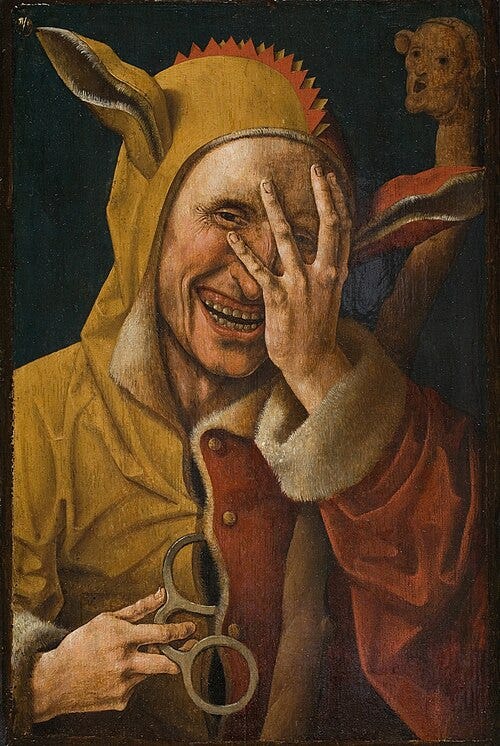
I hope you enjoyed last week’s post about Troilus & Cressida. This week I’m sticking with the same play but asking a different question. Shakespeare invites all sorts of questions, very few of which are ever actually answered. In fact, I’m finding that my answers to questions are like Hydra, once one is answered three more spring up in its place.
The fool trope is common throughout Renaissance literature and Shakespeare uses the the fool in many of his plays. Fools often serve the function of pointing out the ugly truth whether about a character or characters or of the human condition in general. Troilus and Cressida includes many (*many) characters who play the role of fool, but it unclear precisely who the true fool is. For brevity’s sake, we’ll look at only two characters — Thersites and Pandarus, but arguably a main theme of this particular take on the Trojan War is that all the characters are fools.
Troilus and Cressida is a difficult play to define. It mixes elements of comedy, tragedy, and satire. James Simpson argues that this play “vents spleen” and is completely satirical. It is an account of the Trojan War during a time of stalemate. Neither side is winning (and to be honest, we don’t root for either the Greek or the Trojans; they’re all gross). With the backdrop of the Trojan War, Shakespeare includes a love story (yet another love triangle) between Troilus, the youngest son of Priam and a prince of Troy, Cressida, a Trojan lady, and Diomedes, a Greek soldier.
In the first acts and scenes, Pandarus, a Trojan, goes as messenger between Troilus and Cressida acting as the matchmaker (and possible pimp, see below). He claims a kinship to Cressida (Shakespeare often interchanges “uncle” and “cousin” and both are used to describe the relationship between Cressida and Pandarus). We get a sense of his character in his first appearance on stage with Troilus as they negotiate a meeting with Cressida. He says, “I speak no more than truth” to which Troilus responds, “Thous dost not speak so much” (1.1.61-62). Each accuses the other of empty words; Troilus with his love and Pandarus refusing to praise her looks because she’s his kin. The concept of empty words is another common theme throughout Shakespeare but it is especially poignant here with the backdrop of war. What good will words do when actions speak the louder? Another theme of this play is the value of human beings which is ironically communicated through words. Pandarus leaves Troilus declaring that he’ll “leave all as I found it, and there an end” (1.1.84).
The next time we see him is with Cressida and he bumbles through trying to woo her on Troilus’ behalf by claiming Helen (yes, Paris’ Helen who launched a thousand ships) loves Troilus more than Paris. He claims, “I swear to you, I think Helen loves him better than Paris.” To which Cressida responds, “Then she’s a merry Greek indeed” (1.2.102-103). Her response is meant to insult Helen by calling her a whore, which is repeated by many characters about many of the women (and some of the men) throughout the entire play. This fits into the theme of human worth by placing a material value on a person, women especially are commodified and referred to as something to be bought or claimed. At the end of this conversation, the alarm sounds and the warriors return. Pandarus convinces Cressida to watch them come in and he’ll point out all the renowned men but “mark[ing] Troilus above the rest” (1.2.173). I found this odd because a few scenes later, Cressida says she’s loved Troilus for many months, but if she’d never seen him, how could she? One explanation for this scene is to introduce the characters to the stage audience, but another is to show what Pandarus cares about and that he’s not as clever as he thinks in bringing the lovers together because they already wanted to be together. In his descriptions of the men, it is clear he cares about names and fame. This play objectifies both the men and the women in equal measure.
Cressida knows that she too is objectified by Pandarus. He is called away to Troilus’ house and says, “I’ll be with you, niece, by and by.” She asks, “To bring, uncle?” Says he, “Ay, a token from Troilus.” This leads into Cressida’s first soliloquy which sets up much of the action in the love-triangle plot: “By the same token, you are a bawd. Words, vows, gifts, tears, and love’s full sacrifice, he offers in another’s enterprise, but more in Troilus thousand-fold I see than in the glass of Pandar’s praise may be; yet hold I off … Men prize the thing ungained more than it is: … Therefore this maxim out of love I teach: ‘Achievement is command; ungained beseech.’” (1.2.259-274). At first she calls Pandarus a “bawd” which is Elizabethan for pimp or procurer. She understands what he’s doing and for the most part goes along with it. She knows that all the “words, vows, gifts, tears, and love’s full sacrifice” are not real. As Troilus’ representative, Pandarus stands in for Troilus without being the real thing. It is questionable then how true and real Troilus’ feelings are. She then explains that “she holds off” and that she understands the game that is being played in the name of love. She is being sought after by a Trojan prince but sees that “men prize the thing ungained more than it is.” Once gained, she loses. So she offers a maxim for others in her position: “Achievement is command; ungained beseech.” Once “achieved” the woman is commanded [by the man] but until then “ungained” the men beseech, they continue seeking even as it reinforces the commodification and objectification of the “prize.”
Thersites too illustrates the objectification of both men and women. We are introduced to Thersites in the Greek camp as he (possibly she, many productions cast a woman in this role) rails against Ajax, a Greek warrior. Thersites is insulting to everyone; no single character is safe from the wrath of Thersites. He hurls insults such as “mongrel beef-witted lord” (2.1.11) and “scurvy-valiant ass” (2.1.44) at all the Greeks and Trojans too.
How then are they the fools?
Most of the dialogue that includes the word “fool” comes from conversations with Thersites. The first instance is between Achilles, Thersites, and Ajax. Achilles demands “Peace, fool!” Thersites responds, “I would have peace and quietness, but the fool will not” (2.1.77-78). Thersites is speaking about Ajax specifically but also the war in general. Much of the criticism of the war comes from Thersites’ lines. Later, the tables are turned and Thersites demands of Patroclus, “Peace, fool.” Achilles tells Thersites to proceed in describing the fools which he does, claiming, “Agamemnon is a fool, Achilles is a fool, Thersites is a fool, and as foresaid, Patroclus is a fool.” When asked to expand and explain, he says, “Agamemnon is a fool to offer to command Achilles, Achilles is a fool to be commanded of Agamemnon, Thersites is a fool to serve such a fool, and Patroclus is a fool positive” (2.3.51-58). Patroclus asks why his a fool which is never really answered except to say “Make demand of the creator” (2.3.60). Here the word “offer” means attempt; Agamemnon attempts to control Achilles which labels him the fool. There are many other references to “fool” throughout the play but this exchange is the most significant for illustrating the relationship to service and action and the label of fool.
The label of fool for everyone except Patroclus comes with a reason or an exchange of service. Agamemnon tries to control Achilles, Achilles feigns to be controlled, and Thersites serves Achilles. Agamemnon is in this fight for his brother’s sake (Helen was Menalaus’s wife and has been made a cuckold by Paris taking her). Conversely, Pandarus serves no one but himself. He seems outside the hierarchy but that also leaves him without loyalty. When we hear that Cressida is to be traded to the Greeks, Padarus fake weeps only for Troilus not Cressida (4.2.93). Thersites too is without loyalty to either side when he explains during the battle that he is “in everything illegitimate” (5.8.10). He claims no heritage and so is outside the scope of this conflict.
Shakespeare often uses the fool to stand apart from the action to explain or provide insight into the major themes. Pandarus and Thersites are two possible fool characters (of many) in Troilus and Cressida because they explain and promote the action of the play while illustrating something about the human condition that is uncomfortable. Thersites declares, “Lechery, lechery, still wars and lechery; nothing else holds fashion” (5.3.216). The whole epic of the Trojan War is reduced to “lechery” or, in other words, Thersties reduces one of the most well known literary and historical battles ever to sex.
Similarly, Pandarus’ final speech to the audience includes a curse wit a sexual nature; he closes after describing his symptoms (likely syphilis) and “bequeath[s] you my diseases” (5.11.55). In the Royal Shakespeare Production of the final scene, prior to Pandarus’ curse, Troilus takes the stage and proclaims his intent to continue fighting for revenge on Hector’s murder, “Hope of revenge shall hide our inward woe.” While he speaks, Cressida appears in a metal sphere above his head, which is how the play begins but the sphere contains Helen. She is raised up while Pandarus speaks his final lines. What this ending illustrates is the cyclical nature of time as well as the human preoccupation with sex and war.
The story of Troy is one that continues to influence contemporary understanding. Shakespeare’s approach is incredibly cynical. None of the characters on either side are particularly likeable. While many, if not all of the characters, embody elements of the fool character, Pandarus and Thersites tackle the larger portions by illustrating and criticizing the hypocrisy of romantic love and heroic deeds.